Six-sided drilling is worth considering for cabinet components with holes on broad faces and edges, where separate operations would require repeated handling. Side drilling focuses on edge holes and can suit a simpler process or a smaller workload. Door machining may need face drilling and profiling at a machining centre as well.
Two measurable facts guide the choice: how many faces carry features, and how often panel specifications change. Confirm the clamping cycle and accessible features on the quoted configuration.
柜体板件的孔位分布在大面与边上,分开加工可能增加翻面和定位,值得评估六面钻的集中加工能力。侧孔机侧重端面孔,可用于较简单的工艺或较小工作量;门板的面孔、铰链孔与型面还需由适配设备完成。
决定这件事的,是两个可以数出来的事实:你的孔落在几个面上,以及你的板件规格多久换一次。
How does six-sided drilling work in cabinet production?
A six-sided drilling machine uses panel data to coordinate machining on the two broad faces and four edges within the supported processing cycle. It can reduce manual turning and repeated location. Whether regripping is required, and which holes or grooves are accessible, depends on the machine and part.
A typical cabinet-line sequence is:
- The panel arrives with an identity, usually a label or barcode linked to the cutting workflow.
- The machine reads the part information and selects the drilling or grooving program.
- The panel is located and clamped, with any regripping managed by the machine cycle.
- Vertical and horizontal units machine the supported face and edge features.
- The panel moves to unloading and transfer.
Two prerequisites matter beyond the drill bits: the panel must be identifiable, and the selected units and clamps must provide access to the required faces and edges.
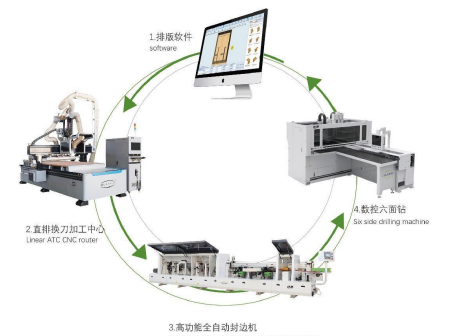
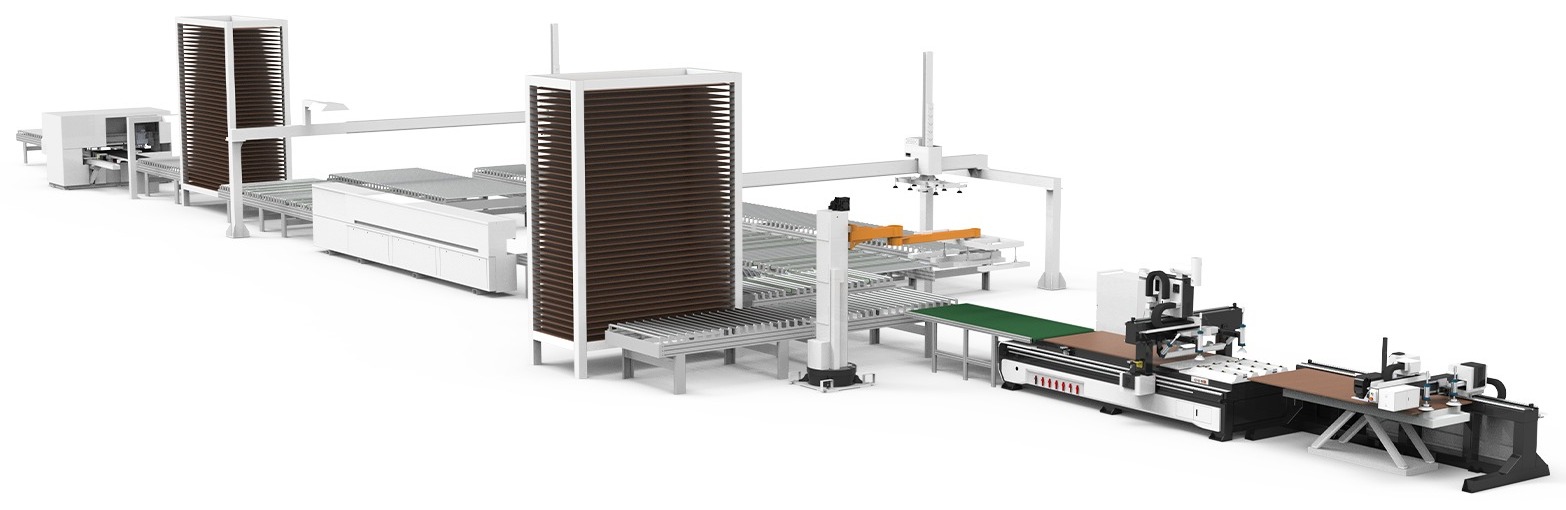
On the advanced cabinet line, drilling follows edge banding. The published process is panel supply, CNC nesting, edge banding, six-sided drilling, unloading and transfer, and line coordination.
六面钻依据板件数据,协调适配钻组加工两个大面与四条边,可减少人工翻面和重复定位。是否需要移夹、哪些孔槽能够完成,以及最小和最大板件范围,都需按具体机型确认;数据与正确的定位夹持缺一不可。
在橱柜线里的顺序是:
- 板件带着"身份"到达——来自开料环节的标签或条码。
- 机器读取板件数据,选出这块板对应的钻孔与开槽程序。
- 板件定位并夹紧,按设备加工循环完成必要的移夹。
- 垂直与水平钻组完成配置支持的面孔与侧孔。
- 板件进入下料与转运。
让这件事成立的有两点,都不是钻头。第一,板件必须可被识别:没有数据,就没有程序选择。第二,机器必须够得到边,也够得到面——这正是它与"从板边作业、另一次装夹"的侧孔方案的分界。
在高级橱柜生产线上,六面钻就排在封边之后——产品页公布的顺序是:板材供给、数控开料、封边、六面钻、下料转运、连线协同。
Drilling arrangements for doors and cabinet bodies
Cabinet bodies can require edge holes for dowels, cam fittings and connectors, as well as face holes for hinges and shelf supports. Separate operations may add handling and reference changes. Doors often combine face or hinge holes with profiles, so their route is frequently led by machining-centre capability.
| Workpiece | Typical features | Configuration to evaluate |
|---|---|---|
| Cabinet sides, shelves and bases | Broad faces and panel edges | Six-sided drilling for supported features |
| Cabinet doors | Face holes, hinge holes and profiles | Machining centre with suitable drilling tools; side drilling if edge holes are needed |
| Small batches and changing specifications | Few holes or varying positions | Compare side-drilling setup time with a data-driven six-sided cycle |
| Panels requiring both grooves and holes | Face and edge features | Six-sided drilling with the required grooving configuration |
The more faces a part needs, the stronger the reason to compare a combined drilling cycle. Capacity, handling and data preparation still belong in that comparison.
柜体需要端面孔(木榫、偏心件、连接件)加上面上的孔(铰链、层板销)。这两类如果分开做,可能增加搬运与基准转换,具体次数取决于加工路线。门板需要面孔、铰链孔,往往还有型面——所以门板的活通常由加工中心主导,而不是由钻孔的"够不够得到"决定。
| 工件 | 典型孔位 | 适配方案 |
|---|---|---|
| 柜体(侧板、层板、底板) | 两个大面 + 四条边 | 六面钻 |
| 橱柜门 | 面孔、铰链孔、型面 | 带钻孔单元的加工中心;有端面孔时配侧孔 |
| 小批量、规格频繁变化 | 孔少、位置常变 | 比较侧孔方案与数据驱动六面钻的实际换型时间 |
| 需一次完成开槽与钻孔的板件 | 面 + 边 | 六面钻,配合开槽程序 |
规律是一致的:一块板需要的面越多,六面钻越站得住。
Six-sided, side and multi-process side drilling
Six-sided drilling brings supported machining on two broad faces and four edges into a data-driven cycle. Confirm access and any regripping rather than assuming every feature is completed in one unchanged grip.
Side drilling machines holes from panel edges. It is the drilling station used in the basic cabinet-line configuration; face operations must be covered elsewhere.
Dual-head and multi-process side drilling extend the side-drilling concept with additional tools or process units. They can complete more edge work in a setup, but the actual reach and tool arrangement must be checked.
A dual-head side drill is not equivalent to a six-sided machine. More tools at the edge do not automatically provide access to broad-face features.
六面钻依据板件数据,将配置支持的面孔、侧孔等集中到加工循环中;移夹过程与可达范围需按机型确认。
侧孔(side drilling)是在以板件侧面为朝向的装夹中加工端面孔,也就是基础橱柜线所用的工位。
双头侧孔与四工序侧孔是侧孔思路的扩展配置:更多钻头或工序单元,可在适配装夹中完成更多端面作业,实际范围需核对。它们缩短了与六面钻的差距,但没有改变基本逻辑——板件仍是从侧面作业。
这个区分在比价时必须分清:双头侧孔不是六面钻。它在端面上每次做得更多,但大面上的加工仍需由适配工位完成。
Compare the process, not just the machine name
| Decision | Side drilling | Dual-head / multi-process side drilling | Six-sided drilling |
|---|---|---|---|
| Accessible features | Supported edge holes | Additional edge operations, according to configuration | Supported features on broad faces and edges |
| Setups per panel | Depends on the hole pattern and other stations | May reduce repeated edge setups | May reduce manual turning; confirm regripping |
| Part data | Manual selection or machine-readable identification | Similar, according to control setup | Panel data selects the machining program |
| Typical fit | Edge-hole work and simpler lines | A greater share of edge operations | Face-and-edge drilling with suitable workload and data |
| Changeover | Measure actual location and program-selection time | Depends on tools and setup | Data-driven, subject to tooling and clamping limits |
| Confirm | Operations still done elsewhere | Tool arrangement and reach | Data format, clamps, sizes and edge access |
The final row is essential. Missing panel data, unreliable label reading, unsuitable workholding or insufficient loading and service space can prevent a well-specified machine from fitting the workshop.
| 决策维度 | 侧孔 | 双头 / 四工序侧孔 | 六面钻 |
|---|---|---|---|
| 加工可达范围 | 仅端面 | 端面,且一次更多 | 两个大面 + 四条边 |
| 单板装夹与移夹 | 多次 | 按刀具与夹持方案核对 | 可减少人工翻面;移夹按配置确认 |
| 数据依赖 | 标签可被人工或机器读取 | 相同 | 板件数据直接选程序 |
| 适用 | 小批量、端面孔、入门线 | 中等产量、端面活偏多 | 有量、孔分布在面与边 |
| 换型表现 | 实测定位与程序切换时间 | 取决于刀具与工位设置 | 由数据与程序驱动,也受刀具和夹持限制 |
| 必须确认项 | 哪些孔仍需人工 | 钻头配置与可达范围 | 数据格式、夹持、四边可达 |
最后一行要细读。除了设备能力,板件数据、读码可靠性、夹持方案与上下料空间,也会影响钻孔工位能否融入实际车间。
Where the three cabinet-line tiers differ
The drilling station is one of the clearest differences between the cabinet-line configurations:
- Basic: side drilling after nesting and edge banding.
- Upgraded: dual-head side drilling, with optional vacuum pressing for compatible membrane doors.
- Advanced: a six-sided drilling route paired with a linear ATC machining centre.
The cabinet-line comparison describes the stations in detail. Panel design and the division of operations should lead the choice, alongside workload and budget.
钻孔工位是三档之间最清楚的标记:
- 基础橱柜线——开料与封边之后配侧孔;
- 升级橱柜线——配双头侧孔,模压门可选真空覆膜;
- 高级橱柜线——在直线 ATC 加工中心之后配六面钻。
这条推进线在基础、升级、高级橱柜生产线差在哪里逐工位写明。如果你正在定档,通常就是钻孔这一项在决定,而钻孔的答案来自你的板件设计,不是预算。
The data questions a quotation should answer
Every drilling route needs a reliable way to identify the arriving panel. Ask three questions before ordering:
- Who creates the labels, and when? Define an identification point compatible with the workflow, commonly before or during nesting, and maintain traceability to drilling.
- What does the drilling station read? Agree the barcode, QR code or program identifier, and assign responsibility for mapping it to a program.
- What happens when a code cannot be read? Define a controlled manual recovery route rather than leaving the whole line waiting.
These are production requirements, not minor IT details. A capable drilling machine cannot make up for unreliable identification or missing program data.
上面每一种钻孔工位,都假设板件到达时已被识别。买之前问三件事:
- 标签谁打、在哪打? 需确定适合工艺的标识节点,常见为开料前或开料时,并保证到钻孔工位的可追溯性。
- 钻孔工位读什么? 条码、二维码还是程序号——以及谁负责把它映射成程序。
- 标签读不出来时怎么办? 必须有一条明确的人工路径,否则整线停在那里。
这些不是 IT 细节。钻孔设备的加工能力,不能代替可靠的板件标识与程序数据。
A drilling-station verification checklist
- Draw three representative panels and mark each hole on its face or edge. Count the present setups for parts with features on several faces.
- Count specification changes per shift and measure the actual setup and program-selection time.
- Verify reach on the edges you need, not only on the broad faces.
- Check the entire data chain: labelling, reading and program selection.
- Run representative panels through the proposed clamps and handling arrangement, including parts near the size limits.
- 画三块典型板件,把每个孔标在它所在的那个面上。若一块板需要多个面的孔,数它的装夹次数。
- 数每班的规格切换次数。换得频繁,就要选重新定位快的方案。
- 确认机器在你实际要钻的边上的可达范围,不只看大面。
- 端到端确认数据链路:标签、读码、程序选择。
- 带着真实夹持把板件走一遍工位,包括接近最大尺寸的板件。
Frequently asked questions
How does six-sided drilling work in a cabinet line?
Panel identification selects the program. The machine locates and clamps the part, then coordinates supported face and edge operations. Confirm the exact cycle, regripping and size limits.
Which should I buy?
Compare a six-sided cycle when cabinet parts need substantial face-and-edge work. Side drilling may suit mainly edge holes or a simpler route. Evaluate output, setup time and data preparation together.
Do doors and cabinet bodies need the same drilling setup?
Not necessarily. Cabinet parts often combine face and edge holes; doors may need face holes, hinge features and profiling at a machining centre, with side drilling where required.
Is dual-head side drilling the same as six-sided drilling?
No. Extra side-drilling tools increase supported edge work, but do not automatically provide the broad-face access of a suitable six-sided configuration.
What must be ready before installing six-sided drilling?
Reliable panel identification, a readable code or identifier, a verified mapping to machining programs, and suitable clamps and handling space.
Can a basic line be upgraded later?
A move to six-sided drilling is a station change that can affect layout and data flow. Reserve space and plan the interface before the first installation.
六面钻在橱柜生产里怎么工作?
通过板件标签或编码选择程序,定位夹紧后协调适配钻组完成面孔和侧孔。具体移夹过程、孔槽范围与板件尺寸限制按设备配置确认。
六面钻与侧孔机该买哪个?
有量、孔分布在面与边的柜体,选六面钻;端面孔为主、小批量、入门线,选侧孔机,并结合产量、准备时间与投资成本评估。
门板与柜体各配哪种钻孔?
柜体需要端面孔与面孔同做,倾向六面钻;门板以面孔、铰链孔与型面为主,由加工中心完成大部分工作。
双头侧孔等于六面钻吗?
不等。双头侧孔在端面上每次做得更多,但板件仍从侧面作业;六面钻通过适配的夹持和加工循环处理面孔与侧孔。
装六面钻之前需要准备什么?
可靠的板件数据:开料前或开料时打印的标签、机器信得过的读码方式,以及从标签到程序的明确映射。
基础线以后能加六面钻吗?
那是工位替换而不是加装,会改变布局与数据流。应在第一台设备安装前就按它预留占地与流向。
Tell us what you need to make
Send material, panel sizes, hole locations on each face and edge, and output per shift. These inputs allow a practical comparison of side and six-sided drilling.
把材料、板件尺寸、孔位分布(哪些面、哪些边)、每班产能发给我们。这决定了选侧孔还是六面钻,也正是我们询盘表的字段。
- 在木工机械页对比板式加工全系列;
- 想看六面钻在完整配置里的位置,见高级橱柜生产线;
- 正在定档?读基础、升级、高级橱柜生产线差在哪;
- 准备定配置:发来材料、板件尺寸、孔位与产能。