When panels spend more time waiting and travelling between stations than being processed, a connected line deserves a closer look. If the bottleneck is a machine, improve that operation; if it is the handoff between machines, evaluate the line as a whole. Payback still depends on investment, labour, utilisation and the work you actually sell.
Run the following four-step check in your own workshop before asking for a quotation.
The central question is whether daily output is limited by coordination rather than cutting. The rest of this guide helps you test that question against your own production.
当板材在工位之间等待、搬运的时间明显影响产出时,就值得评估整线。瓶颈在单机,先改善该工序;瓶颈在设备之间,再考虑连线。实际回本周期还需结合投资、人工、设备利用率与订单结构核算。
下面这套四步测试,你可以本周就在自己车间里跑一遍,再去谈报价。
一句话结论
当决定日产量的是"衔接"而不是"切削"时,整线才成立。
后面的内容,都是用来验证这句话在你厂里是否属实。
How many machines does a cabinet workshop need?
Start with the operations you keep in-house, normally cutting, edge banding and drilling, and provide enough buffer capacity to absorb differences in cycle time. The starting point is the process, not one machine for every product or the largest machine available.
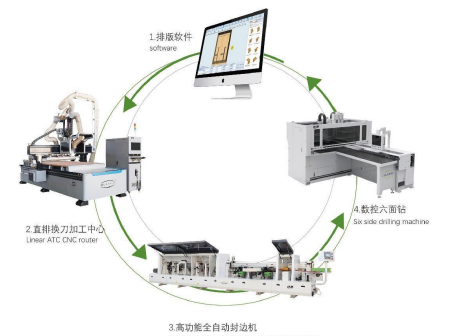
A cabinet panel typically passes through the following stages:
| Station | What happens to the panel | Typical equipment |
|---|---|---|
| 01 Panel supply | Retrieve and identify stock | Storage and loading system |
| 02 Cutting | Nest or saw to size | CNC nesting machine or panel saw |
| 03 Edge banding | Apply edging to specified sides | Automatic edge bander |
| 04 Drilling | Machine holes and grooves from part data | Six-sided or side drilling machine |
| 05 Transfer | Move finished components to assembly or storage | Unloading and transfer equipment |
One machine per operation is a planning starting point; actual quantities depend on capacity and the product mix. The decision to connect the equipment depends on differences between station cycles. If cutting is faster than edge banding, the stack before the edge bander is a sign of mismatched flow, not simply a storage problem.
一个工序一台设备,再在工序之间留出足够的缓冲,去吸收彼此节拍的差异。不是一种产品一台设备,也不是能买多大就买多大。
一块橱柜板件通常要走完这些工序:
| 工位 | 板件发生了什么 | 常见设备 |
|---|---|---|
| 01 板材供给 | 从库存取出并识别 | 仓储与上料系统 |
| 02 开料 | 按尺寸套裁或锯切 | 数控开料机或电子锯 |
| 03 封边 | 指定边部封边 | 自动封边机 |
| 04 钻孔 | 依据板件数据加工孔槽 | 六面钻或数控侧孔机 |
| 05 转运 | 成品板件转向组装或入库 | 下料与转运设备 |
可先按厂内保留的工序配置设备,再依据各工位产能确定实际数量。但决定你要不要"整线"的,是另一个数字:这些工序之间的节拍差有多大。
开料节拍短、封边节拍长,板件就会堆在封边机前。这堆料不是仓储问题,而是两道工序按两种节奏在跑,中间靠人一整天在搬。
What is a process buffer, and why does it matter?
A process buffer is a defined holding area between operations with different cycle times. It allows one station to continue while the next finishes its work. Providing a suitable buffer can be more practical than forcing every station to run at the same speed.
Buying a faster machine only helps when the machine itself is the constraint. When transfer or coordination is the constraint, increasing upstream speed can make the queue longer.
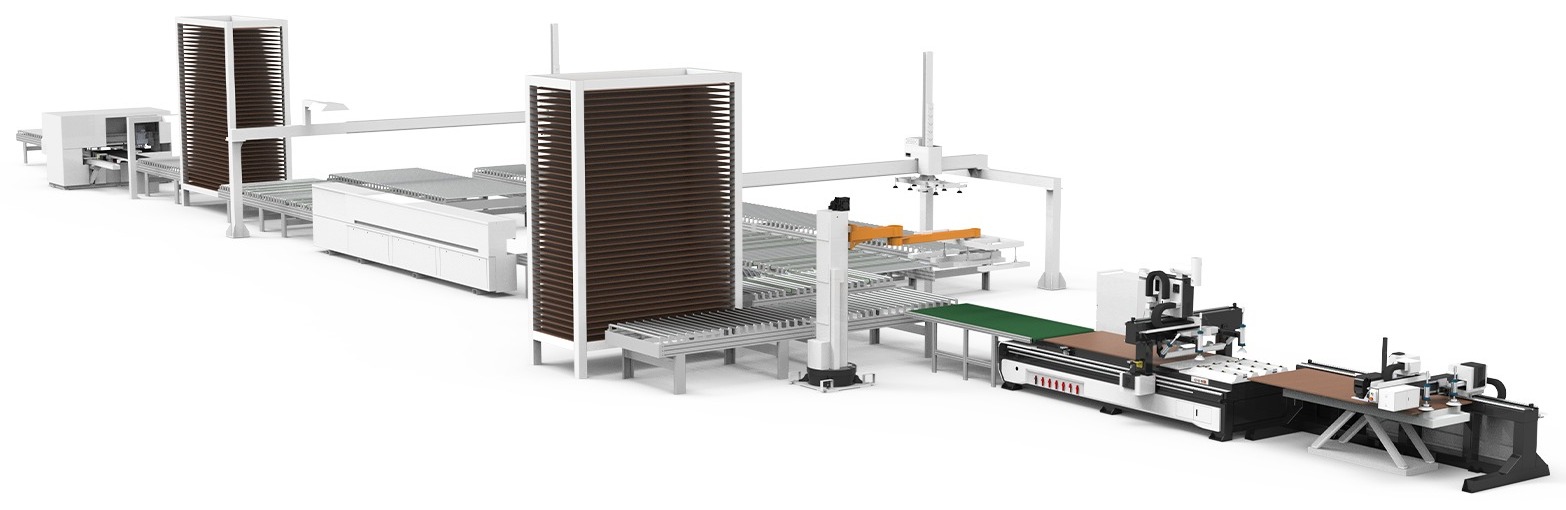
The iGC-1T1 automatic one-to-one furniture line lists two buffers, before and after edge banding. Its process combines labelling, nesting, buffered edge banding and drilling with handling arrangements confirmed for the project. A buffer is part of the configuration, not an afterthought.
Where should buffers go?
Plan a buffer where neighbouring stations run at different rates, or where one must stop to change tools, edging or part specifications while another continues.
- Between nesting and edge banding, where the operating rhythms differ.
- Between edge banding and drilling, allowing the required cooling, curing or reorientation.
- Before any operation that needs changeover preparation for different part families.
Process buffer(工序缓冲)是设在两道节拍不同的工序之间的暂存位。它让快的工序继续跑,慢的工序干完自己的活,通常比把两道工序强行调成同一速度便宜得多。
这个概念之所以重要,是因为大多数工厂一遇节拍对不齐,第一反应是买更快的机器。只有当不齐出在机器本身时,这招才有效;如果不齐出在衔接上,更快的机器只会让机器前面的堆料堆得更快。
IGOLDENCNC 的自动一对一板式家具线 iGC-1T1,产品页给出的流程里明确写了两处 process buffer,位置分别在封边前后。这个细节值得细读:它不是七台机器排成一排,而是"贴标、开料、带缓冲的封边、钻孔"由机器人搬运与物料缓冲串起来。缓冲是配置的一部分,不是配件。
缓冲该放在哪
凡是相邻两道工序节拍不同,或者一道工序要停下来换刀、换边条、换规格而另一道还在跑的地方,就该有缓冲。实践中基本固定在这几处:
- 开料与封边之间——封边机与开料机的节奏天然不同;
- 封边与钻孔之间——封完边的板件需要冷却、固化或重新定向;
- 任何需要为不同板件族做换型准备的工序之前。
The seven stages of an automatic one-to-one line
The iGC-1T1 process is presented as seven stages:
- Automatic labelling. Panels receive identification and machining-task data.
- CNC nesting. Cutting follows the assigned program.
- Process buffer. Parts wait between stations with different cycle times.
- Edge banding. Apply the specified edging; confirm return and loading arrangements.
- Process buffer. Provide the second holding stage before drilling.
- Six-sided drilling. Select drilling and grooving programs from panel data.
- Line coordination. Confirm equipment interfaces, task data and the scope of material handling.
Labelling comes before cutting because the line relies on part data rather than an operator reading a paper list. Coordination is a separate stage because interfaces need as much attention as individual machines.
以下顺序取自 iGC-1T1 的产品页:
- 自动贴标——板件接收标签数据,被识别出各自的加工任务。
- 数控开料——按指定的加工程序完成切割。
- 工序缓冲——板件在节拍不同的工序之间等待。
- 封边——按需封边;回程方式与上下料方式需要确认。
- 工序缓冲——第二处缓冲,进入钻孔前使用。
- 六面钻——依据板件数据自动选择钻孔与开槽程序。
- 连线协同——设备接口、任务数据与搬运范围需逐项确认。
两点值得注意。第一,贴标在开料之前,说明这条线是靠板件数据驱动的,不是靠操作工看料单。第二,流程以"协同"收尾而不是以某台机器收尾,因为安装成败大多发生在接口上。
Standalone, semi-automatic and automatic: what changes?
Compare what happens to the panel between operations, rather than assigning a simple automation ranking.
| Decision | Standalone | Semi-automatic line | Automatic one-to-one line |
|---|---|---|---|
| Panel movement | Operators and trolleys | Mechanical handling plus manual steps | Specified robotic transfers |
| Part identity | Operator reads the cutting list | Labels before or during nesting | Labels at station 01; downstream reading |
| Work in progress | Stacks beside each machine | Reduced, with some manual buffering | Defined buffer positions |
| Changeovers | Independent machine schedules | Coordinated scheduling | Line-level scheduling |
| Space | Flexible, with gradual additions | Defined flow required | Fixed layout and footprint |
| Confirm before ordering | Capacity of each operation | Which transfers remain manual | Interfaces, buffers, data format and layout |
There are deliberately no output or price figures in this comparison. Both depend on the panel mix, shifts and project scope; they cannot be established from the line label alone.
有用的对比不是"自动化程度有多高",而是"板件在工序之间经历了什么"。
| 决策维度 | 单机 | 半自动线 | 自动一对一整线 |
|---|---|---|---|
| 板件流转 | 人工、推车或手搬 | 部分机械化、部分人工 | 工位间机器人搬运 |
| 板件身份 | 操作工看料单 | 开料前或开料时贴标 | 01 工位贴标,下游读取 |
| 在制品 | 每台机器前堆料 | 减少,但仍需人工缓存 | 存放在定义好的缓冲位 |
| 换型 | 各机独立 | 需串联排程 | 全线统一排产 |
| 场地 | 灵活、可陆续添置 | 需要明确流向 | 需要固定布局与占地 |
| 必须确认项 | 各工序设备产能 | 哪些衔接仍走人工 | 接口、缓冲数量、数据格式、布局 |
注意这张表里没有的东西:没有产能数字,也没有价格。它们取决于你的板件结构和班次安排;在这些信息明确之前给出的任何数字,都只是猜测。
What determines the cost of a panel furniture line?
The complete budget includes the equipment around the main machines as well as the machines themselves:
- Main machines and specifications. Nesting, edge banding and drilling each have configuration choices that affect price.
- Handling and transfer. Robots, roller conveyors, lifts and turning devices need their own budget.
- Buffers. Each buffer requires space, a station and a control point.
- Data and interfaces. Labels, barcodes, nesting software and machine data formats must work together.
- Site preparation. Power, extraction, compressed air, floor conditions and clear height must suit the fixed sequence.
- Commissioning, training and spares. List these deliverables explicitly instead of assuming they are included.
A quotation listing only machines is not yet a complete line quotation. Ask how a panel travels from station 02 to station 04 and who supplies each connection.
整线的成本,更多由机器"周边"决定,而不是机器本身。实际的成本项是:
- 主机数量与规格。 开料、封边、钻孔是三个成本中心,每一类都有会显著改变价格的配置差异。
- 搬运与转运设备。 机器人、滚筒线、升降与翻板装置,占比往往高于买方预期。
- 缓冲位。 每个缓冲都意味着一处工位、一块占地和一个控制点。
- 数据与接口。 标签、条码、排版软件与机器之间的数据格式必须一致。
- 现场工程。 电力、吸尘、压缩空气、地面平整度与净空高度,一旦工位固定成序列就都变成硬性要求。
- 调试、培训与备件。 操作指导、培训与备件需求属于交付范围,应逐项列明而不是默认包含。
如果一份报价只列了机器,它还不是整线报价。要问一句:板件从 02 工位到 04 工位之间,是怎么走的?
A four-step check you can run this week
Collect your own figures before discussing suppliers. The framework makes the later conversation specific.
1. Measure the real cycle at each station
| Process | Cycle per batch | Time per changeover | Stops per shift |
|---|---|---|---|
| Nesting | Record on site | Record on site | Record on site |
| Edge banding | Record on site | Record on site | Record on site |
| Drilling | Record on site | Record on site | Record on site |
Use measured results, not brochure speeds. Include time spent waiting for the previous operation.
2. Count handling events
Follow one panel from nesting to drilling and count each lift, stack, move and restack. If handling is frequent while the machines have spare capacity, the handoffs deserve attention.
3. Check part identification
A connected line assumes that every panel can be identified at every station. If the workshop still depends on paper cutting lists, labelling and part data may be the first investment, before robotics.
4. Measure the site
Confirm footprint, flow direction, power, extraction and clearance. A fixed line is difficult to reconcile with a workshop layout that changes every month.
在找任何供应商之前,先在自己车间把这几张表填了。数字是你的,框架是为了让后面的对话有效。
第一步:写下每道工序的真实节拍。
| 工序 | 每批节拍 | 每次换型耗时 | 每班停机次数 |
|---|---|---|---|
| 开料 | 现场记录 | 现场记录 | 现场记录 |
| 封边 | 现场记录 | 现场记录 | 现场记录 |
| 钻孔 | 现场记录 | 现场记录 | 现场记录 |
要实测,不要抄样本参数。把"等上一道工序"的时间也算进去。
第二步:数一遍搬运次数。 跟一块板从开料到钻孔,数它被抬起、码放、移动、再码放了多少次。如果次数很高而各道工序本身并没有跑满,制约就在衔接上。
第三步:检查板件有没有"身份"。 整线假设每块板在每个工位都可被识别。如果厂里还在用纸质料单,第一笔投入应该是贴标与板件数据,而不是机器人。
第四步:量场地。 确认你想要的那条序列的占地、流向、供电、吸尘与净空。整线需要固定布局;一个月变一次形状的车间,会和整线互相别扭。
When should you postpone a connected line?
Review the prerequisites before proceeding when:
- The order mix changes so often that scheduling must continually be rebuilt.
- The site cannot accommodate a stable flow and footprint.
- Part data, labels or a bill of materials are missing, or downstream stations cannot read the nesting output.
- Power and dust extraction are not ready, limiting safe and effective operation.
- Existing machines already have unused capacity. Adding another line creates another cost base rather than automatically lowering unit cost.
In these situations, one improved operation or two machines with better handling may be the practical next step. Reassess a complete line once the constraint moves.
遇到以下情况,应先解决前提条件,再评估整线:
- 订单结构变化太频繁,整线排产改的次数比跑的次数还多;
- 场地给不出固定的流向与占地;
- 没有板件数据——没有标签、没有 BOM、开料输出下游读不了;
- 电力与吸尘没到位,设备运行与产能会受到限制;
- 现有设备还有富余产能。在闲置产能之上再加一条线,不降低单位成本,只是多了一套成本基数。
遇到这些情况,诚实的答案是先上一台设备,或两台设备加一套更好的衔接方式,等制约真的转移了再回来谈整线。
Frequently asked questions
How many machines does a cabinet workshop need?
Plan around each in-house operation, usually cutting, edge banding and drilling, plus handling and buffers. Actual machine quantities depend on the workload and capacity of each station, not simply the building size.
How should the handoffs be planned?
Compare neighbouring station cycles and add buffers where the mismatch cannot be removed. Plan connections alongside equipment selection because the handoffs can constrain daily output.
Where should the first investment go?
Address the current constraint. A queue before the edge bander may point to edge banding or its loading arrangement; a queue before nesting may point to cutting. Check the actual cause before buying equipment further downstream.
Which costs are easiest to miss?
Handling, buffers, data interfaces, power and extraction work, commissioning, training and spares. These may explain much of the difference between two quotations.
How many buffers are needed?
A buffer holds work between stations with different rhythms. The number depends on the process; iGC-1T1 lists two, between nesting and edge banding and between edge banding and drilling.
Can a line be installed in phases?
Yes, if the overall layout is planned first. Equipment can be added in stages, but flow direction, space and data formats should be agreed before the first installation.
橱柜厂到底需要几台设备?
一个自制工序一台——通常是开料、封边、钻孔——再加工位之间的搬运与缓冲能力。数量由你保留在厂内的工序数决定,不由厂房大小决定。
板式家具生产线的工序衔接该怎么规划?
先让相邻工序的节拍对齐,无法消除的差异处插入缓冲。先规划衔接再选机器,因为日产量通常由衔接决定。
板式家具厂第一笔钱该花在哪?
花在当下最限制产量的那道工序上。如果板件堆在封边机前,制约是封边或其上料;如果堆在开料前,制约是开料机。先买下游设备,只会把堆料的位置挪一下。
做整线预算时最容易漏掉哪些成本?
搬运与转运设备、缓冲位、数据与接口工程、电力与吸尘等现场工程,以及调试、培训和备件。这些都不在机器价目表里,却常常是两份报价差距的真正来源。
Process buffer 是什么,需要几处?
是设在两道节拍不同的工序之间的暂存位。数量取决于有多少对相邻工序节奏不一致——iGC-1T1 用了两处,分别在开料与封边之间、封边与钻孔之间。
整线能不能分期上?
可以,前提是布局一开始就按整线规划。工位可以按序添置,但流向、占地与数据格式要在第一阶段安装前定下来。
Tell us what you need to make
Bring four inputs: material, part dimensions, required operations and planned output. They turn a configuration discussion into a concrete review.
带上四样东西,配置讨论就能变成具体的:材料、工件尺寸、需要的工艺、计划产能。这四项也正是我们询盘表的字段。
- 在板式家具与材料加工连线页对比可连接设备;
- 本文对应的七工位流程,见自动一对一板式家具线;
- 如果制约在开料而不是衔接,先看ATC 雕刻机配置;
- 拿不准该上哪一档?接着读基础、升级、高级橱柜生产线差在哪;
- 准备开聊:把材料、板件尺寸、工艺与产能发给我们。